specmet usa — Molybdenum Division
Molybdenum &Molybdenum Alloys
The fifth-highest melting point of any element. The backbone of high-strength steel and superalloy production. From pure molybdenum rod and TZM alloy to ferromolybdenum and sputtering targets — we connect surplus industrial inventory with qualified buyers worldwide. Commission-only. No risk to the seller.
80% Goes Into Steel
Approximately 80% of all molybdenum produced globally is consumed by the steel industry as an alloying addition. Ferromolybdenum surplus from steel mill inventory reductions and reformulated melt schedules is one of the most consistently active secondary markets we work in.
All Grades & Forms
Pure molybdenum (Mo-1, Mo-2), TZM alloy, Mo-La, ferromolybdenum, molybdenum oxide, sputtering targets, Mo-Cu heat sinks, Mo-W alloys, and molybdenum powder — we broker the complete molybdenum product spectrum.
Commission on Delivery
We earn our commission only after your material ships and the buyer confirms receipt. SpecMet USA never takes ownership of your inventory. No upfront fees, no retainers, no obligation.
Why Molybdenum Commands Industrial Demand
Essential Properties.Irreplaceable in Steel & High-Temperature Systems.
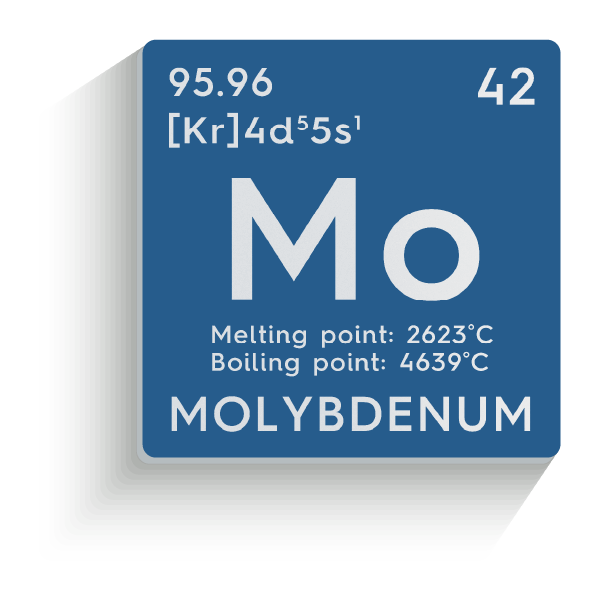
Molybdenum's combination of the fifth-highest melting point of any element (2,623°C), excellent strength retention at elevated temperatures, outstanding corrosion resistance, and ability to form stable carbides in steel make it one of the most strategically important industrial metals on earth. No viable substitute exists in stainless steel production and high-strength alloy manufacturing.
PURE MOLYBDENUM (Mo)
Mo-1 (99.95%) · Mo-2 (99.90%) · Rod · Sheet · Wire
Wrought pure molybdenum in rod, sheet, plate, foil, and wire forms. Used in high-temperature furnace components, glass melting electrodes, semiconductor processing equipment, and vacuum technology applications where low vapor pressure is critical.
TZM — Ti-Zr-Mo ALLOY
0.5%Ti · 0.08%Zr · 0.02%C · Balance Mo
Molybdenum's premier structural alloy. TZM doubles the high-temperature strength of pure molybdenum above 1,000°C, raising the recrystallization temperature to ~1,100°C and dramatically improving creep resistance. The standard for rocket nozzles, hot press tooling, and furnace hardware requiring load-bearing capability above 900°C.
Mo-La — LANTHANUM-DOPED Mo
Mo + 0.3–1.3% La₂O₃ · MoLa · ML Series
Lanthanum oxide dispersion-strengthened molybdenum with superior creep resistance and recrystallization stability at extreme temperatures. Preferred for ion implantation hardware in semiconductor fabs, glass fiber spinning bushings, and ultra-high-temperature furnace applications above TZM's effective range.
FERROMOLYBDENUM (FeMo)
FeMo60 · FeMo65 · FeMo70 · Broken Lump
The primary vehicle for adding molybdenum to steel melts — approximately 60–70% Mo balance iron. The single largest form of molybdenum consumption globally. Used in stainless steels (316 requires ~2.5% Mo), high-strength low-alloy (HSLA) steels, tool steels, and engineering steels requiring hardenability and corrosion resistance.
Mo SPUTTERING TARGETS
Pure Mo · Mo-Nb · Mo-W · Planar & Rotary
High-purity molybdenum targets for physical vapor deposition (PVD) of thin films in flat panel display (FPD) gate electrode layers, solar cell back contacts (CIGS), and semiconductor metallization. One of the largest-volume sputtering target materials by mass consumed globally.
Mo-W & Mo-Cu ALLOYS
Mo-30W · Mo-Cu Heat Sinks · MoSi₂
Mo-W alloys combine molybdenum's lower density with tungsten's extreme hardness and molten metal resistance — used for impellers and stirrers in molten zinc applications. Mo-Cu composites provide controlled thermal expansion and high thermal conductivity for power electronics packaging. MoSi₂ serves as a high-temperature furnace heating element material.
Surplus Materials We Handle
Specific Products &What Buyers Pay For
Molybdenum surplus spans from large-volume ferromolybdenum lump handled in metric ton quantities to high-value precision sputtering targets measured in kilograms. Each product category has a distinct buyer profile and documentation requirement. Below are the most actively traded molybdenum surplus categories we broker.
Market Context: Molybdenum is designated a critical mineral by the U.S. government and the EU. Global supply is concentrated in a small number of mines, with the United States, China, Chile, and Peru as the primary producing nations. Historical price volatility means surplus inventory management is a genuine strategic concern for procurement and inventory managers in steel, aerospace, and electronics industries.
PURITY
≥ 99.95% Mo (Mo-1) / ≥ 99.90% (Mo-2)
MELTING POINT
2,623°C (4,753°F)
DENSITY
10.28 g/cm³
KEY STANDARDS
ASTM B386 (sheet/plate), ASTM B387 (rod/bar)
End-Use Applications
Vacuum Furnace Hot Zones
Glass Melting Electrodes
Electron Beam Evaporation Sources
Semiconductor Processing Equipment
Radiation Shielding (Vacuum)
High-Temp Fixtures & Tooling
Ion Implant Hardware
Active Furnace & Semiconductor Buyers
Vacuum furnace OEMs and rebuilders, semiconductor equipment manufacturers, and glass industry suppliers are consistent buyers of surplus pure molybdenum rod and sheet. Purity certification and physical condition documentation (no oxidation, no surface damage) are the key buyer requirements. Even oxidized or damaged pure Mo retains significant value as reclaim feedstock for powder metallurgy processors.
TITANIUM CONTENT
0.50% Ti
ZIRCONIUM / CARBON
0.08% Zr / 0.02% C
RECRYSTALLIZATION TEMP
~1,100°C (vs ~900°C for pure Mo)
KEY STANDARDS
ASTM B386 Type 364, ASTM B387 Type 364, AMS 7817
End-Use Applications
Rocket Nozzle Inserts
Hot Press Tooling & Dies
Superalloy Forging Tooling
Vacuum Furnace Structural Parts
Nuclear Fusion Components
Aerospace Thermal Protection
Glass Industry Tooling
Hypersonic Vehicle Structures
Aerospace & Defense Program Surplus
TZM rod, plate, and machined blanks from canceled aerospace programs, closed hot press tooling shops, and nuclear research facility decommissioning represent high-value surplus that moves quickly to aerospace fabricators, furnace builders, and research institutions. ASTM B386 Type 364 or AMS 7817 documentation significantly strengthens buyer interest and pricing.
La₂O₃ CONTENT
0.3–1.3% La₂O₃ (grade dependent)
STRENGTHENING
Oxide Dispersion Strengthening (ODS)
KEY ADVANTAGE
Superior creep resistance above TZM range
FORMS AVAILABLE
Rod, bar, sheet, plate, machined parts
End-Use Applications
Semiconductor Ion Implantation Hardware
Glass Fiber Spinning Bushings
Ultra-High-Temp Furnace Components
High-Temp Structural Supports
Incandescent Lamp Mandrels
Niche Material, Dedicated Buyers
Mo-La surplus is less frequent than TZM but commands a premium pricing position due to its specialized production process and narrow buyer base. Semiconductor equipment manufacturers and glass industry suppliers represent the primary buyer pool. Proper material identification — distinguishing Mo-La from pure Mo or TZM — is essential for realizing full surplus value. We help sellers verify grade identity before approaching buyers.
MOLYBDENUM CONTENT
60–70% Mo (FeMo60/65/70)
BALANCE
Iron (Fe) + trace Si, S, P, Cu
PHYSICAL FORM
Broken lump, crushed, or granulated
KEY IMPURITY LIMITS
S ≤ 0.1%, P ≤ 0.05% (standard grade)
End-Use Steel Grades
316 / 316L Stainless Steel
High-Strength Low-Alloy (HSLA) Steels
M2 / M42 High-Speed Tool Steel
H-Series Hot Work Die Steels
Pressure Vessel & Boiler Steels
Nickel-Base Superalloy Additions
Chrome-Moly Structural Grades
Highest Volume Mo Surplus
FeMo surplus from steel mill inventory reductions and specialty alloy producer reformulations is the most common and most liquid molybdenum surplus we broker — typically traded by the metric ton. Chemical analysis for Mo%, S%, and P% is the standard buyer requirement. Material from known, established producers commands better pricing than material of uncertain origin.
PURITY
99.95% to 99.9999% Mo
TARGET TYPES
Planar disc/rectangular, rotary cylindrical
KEY INDUSTRIES
FPD / TFT, CIGS solar, semiconductor
SURPLUS FORMS
Used (partially eroded), virgin (process change), bonded
End-Use Applications
LCD / OLED TFT Gate Electrodes
CIGS Solar Cell Back Contacts
Semiconductor Metallization
Diffusion Barrier Layers
Hard Coating Deposition
High Value-Per-Unit Surplus
Molybdenum sputtering targets represent some of the highest per-kilogram value surplus in the molybdenum product family. Even heavily eroded used targets contain significant recoverable molybdenum. New or lightly used targets from process recipe changes or fab upgrades command near-market pricing. Backing plate material (copper, stainless) must be separated from Mo content for accurate valuation — we assist sellers with this assessment.
MOLYBDENUM CONTENT
57–60% Mo (technical grade)
PHYSICAL FORM
Briquettes, granules, or calcined powder
CHEMICAL GRADE
99%+ MoO₃ for catalyst applications
KEY BUYERS
FeMo producers, catalyst manufacturers
End-Use Applications
Ferromolybdenum Production
Petroleum Refining Catalysts (HDS)
Chemical Process Catalysts
Molybdenum Metal Production
Pigments & Colorants
Corrosion Inhibitor Formulations
Commodity-Scale Surplus
MoO₃ surplus is typically handled in large quantities — drums, bulk bags, or bulk shipments — and priced on a per-pound-of-contained-molybdenum basis. Chemical analysis (Mo%, particle size, moisture content) is the primary buyer documentation requirement. We work with sellers to match material quantity and grade to the most appropriate buyer — FeMo producers for technical grade, catalyst manufacturers for high-purity chemical grade.
PURITY RANGE
99.5% – 99.99%+ Mo (grade dependent)
FSSS SIZE RANGE
1 µm (fine) to 20+ µm (coarse)
AM POWDER
Spherical, 15–45 µm or 45–106 µm
KEY STANDARDS
ASTM B387 feedstock, customer specifications
End-Use Applications
Pure Mo & TZM Sintering
Sputtering Target Production
Thermal Spray Coatings
Metal Injection Molding
Additive Manufacturing (LPBF)
Mo-Cu / Mo-W Composite Fabrication
Grade Matching Is Critical
Molybdenum powder surplus value depends critically on purity, particle size, and storage conditions — oxidation begins at 400°C but even room-temperature storage can cause surface oxidation affecting sinterability. Original certificates of conformance with FSSS data and chemical analysis are the primary buyer requirements. We help sellers organize available documentation and assess what re-testing may be needed before bringing material to market.
The Process
How Our Brokerage Works
Simple, transparent, and commission-only. You don't pay us anything until a qualified buyer receives your material.
01
Submit Your Inventory
Tell us what you have — material type, grade, quantity, form, and any available analysis or mill certs. The more detail you provide, the faster we can identify buyers.
02
We Identify Buyers
We work our network of qualified industrial buyers — superalloy producers, steel mills, aluminum foundries, plating operations, and fabricators — to find the right match for your material.
03
Terms Are Agreed
Once a buyer is identified, terms are negotiated between you and the buyer. We facilitate but do not take title to the material — this is a direct seller-to-buyer transaction.
04
We Earn on Delivery
Our commission is collected only after the product ships and is confirmed received. No upfront fees, no retainers. Our success depends entirely on yours.
Inventory We Handle
Forms & Conditions Accepted
We work with molybdenum materials across all product forms — from metric ton lots of ferromolybdenum lump to individual precision-machined TZM components and kilogram lots of high-purity sputtering targets. Prime certified material commands the best pricing; reclaim and scrap has an active buyer base at appropriate valuations.
PURE Mo ROD & BAR
Mo-1 and Mo-2 grades, all diameters, sintered or wrought
Mo SHEET & PLATE
All thicknesses, pure Mo and TZM, prime and off-cut
TZM ROD, SHEET & MACHINED PARTS
ASTM B386 Type 364 and AMS 7817, all forms
Mo-La ALLOY PRODUCTS
Lanthanum-doped Mo in rod, sheet, and machined form
FERROMOLYBDENUM (FeMo)
All grades (FeMo60–70), broken lump, bulk quantities
MOLYBDENEUM TRIOXIDE (MoO₃)
Technical and chemical grades, briquetted or granulated
SPUTTERING TARGETS
Used and new Mo targets — planar, rotary, bonded or unbonded
MOLYBDENUM POWDER
Sintering, thermal spray, and AM grades in all particle sizes
Mo SCRAP & RECLAIM
Turnings, off-cuts, worn furnace parts — all grades of Mo-bearing scrap
Ready to Move Your Inventory?
Tell Us What You Have
Submit your inventory details and a member of the SpecMet USA team will respond within one business day. We work with procurement managers, inventory controllers, plant managers, and CFOs across steel, aerospace, semiconductor, energy, and industrial manufacturing sectors.
No obligation. No upfront cost. No commitment required to submit an inquiry. If we can identify a qualified buyer for your molybdenum material, we will — and we earn our commission only when the deal closes.
All inquiries are handled with strict confidentiality.
By submitting this form you agree to be contacted by the SpecMet USA team. We do not share your information with any third party without your explicit consent.